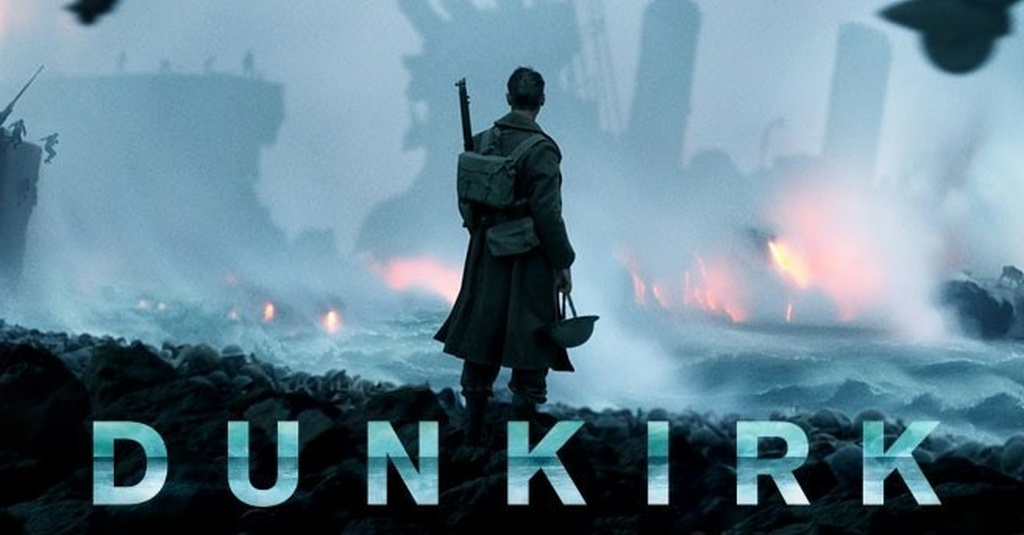
This was the final movie that I needed to watch to complete my viewing of Christopher Nolan’s entire filmography so far. And this was certainly a solid film to end on.
The best thing about this movie is the cinematography. Nolan does a brilliant job in immersing the viewer into the atmosphere of a war zone– whether that be in the air, land or water. There are so many incredible shots in this film. One of the best was the wide scale shot of the ocean with Navy boats.
With the excellent cinematography came some very tense moments. Scenes where soldiers are in flooding boat cabins hearing and seeing gunshots and explosions was very heart pounding, and the decision to keep the camera in the perspective of the soldiers was a great idea. The best scene of tension was the pilot trying to escape from the flooding plane.
The score to this film is also great. I also really enjoyed how unique of a war film this was. The only actual combat featured is a couple of dogfights. In reality, most of the film is really an wide scale fallback by Allied Forces and the process of trying to escape amidst enemy attacks. Most WWII films would have focused on the battlefield and the combat side. Nolan takes a creative direction to make the film more of an evacuation than combat and depict it from all three fronts. I also thought the film ended on a strong note with a powerful speech.
A common criticism of this film is that the characters are very weak and poorly fleshed out. To be honest, I don’t even recall if the name of the main character is given. While this is somewhat true, I think the point of the film was to display the evacuation as a collective effort rather than focus on a select group of people. The film is intentionally focusing more on the heroic efforts of soldiers and civilians alike to save as many people as possible as well as depict the horrors of what the Dunkirk soldiers as a whole had to go through to reach safety. In a way, all of the people at Dunkirk were collectively one character.
On more negatives, I found the handling of George’s death to be rather cold. He dies because he hits his head on a cabinet after trying to restrain a manic soldier. The people who he travelled with barely show emotion when he dies and mostly keep a straight face. Even at the end of the film when his picture is in the newspaper, they still keep a rather expressionless face.
I also was a little confused on Harry Styles’ character. It seemed implied that he murdered a soldier that he suspected to be a spy and the movie never touches on it again. On a side note, I was also a little confused by the time measurements given under the description of the fronts and I don’t think the film did a good job of explaining it. As a minor nitpick, I’m not sure why the film ended on the main character’s face as opposed to ending on the burning plane.
This was a really good film from Nolan. I wouldn’t necessarily say it’s great, but I definitely need to watch it again and after that, I would probably think this is a great film.



Leave a Reply